Ever wondered what open captions are and how they differ from closed captions? Whether you’re streaming movies in Los Angeles, attending a virtual seminar in London, or watching content online, understanding open captions meaning can enhance accessibility and improve your viewing experience. This guide will explain everything you need to know about open captioning, from its purpose to practical use.
Open Captions vs. Closed Captions
- Open captions are permanently burned into the video ensuring they always appear Universal Accessibility 🎞️✅
- Closed captions can be turned on or off by the viewer using remote control Viewer Control 🎚️📺
- Open captions eliminate the need for any specific decoder hardware or settings Hardware Free 🚫🔌
- Closed captions rely on separate metadata often transmitted with the video signal Data Dependent 📡💾
- Open captions guarantee complete consistency across all playback devices reliably Playback Uniformity 🌐💯
- Closed captions offer flexibility allowing users to customize font size or colour Customization Option 🎨🔤
- Open captions are often preferred in public spaces like restaurants or gymnasiums Public Viewing 🏟️🍽️
- Closed captions are common for home viewing offering personal control over display Home Entertainment 🛋️🏠
- Open captions can sometimes obscure important visual information or graphics sadly Visual Obstruction 🖼️🚧
- Closed captions can be easily moved or resized to avoid covering essential video elements Flexible Placement 📐📍
- Understanding this difference is key for choosing the right accessibility solution Accessibility Choice 🔑🚪
- Open caption files are typically permanent parts of the finished video production Production Stage 🎬✂️
- Closed caption data streams separately requiring compatible player or platform support Stream Requirement 🌊🖥️
- The primary distinction lies in the ability to disable the on-screen text display Primary Difference 🛑🔄
- Open captions ensure the content is immediately accessible to everyone watching Immediate Access 🏃♀️💨
- Closed captions require the user to actively select the feature to see the text User Action 👇🖱️
- Using open captions guarantees the message reaches audiences in noise-heavy environments Noisy Locations 🗣️🔇
- Closed captions give power to the user ensuring discreet viewing if they prefer silence Discreet Viewing 🤫👤
- Open captions are perfect for educational content where text presence is always critical Educational Focus 🎓📚
- Both caption types improve SEO and significantly boost online content discoverability SEO Boost 🚀📈
What are Open Captions?
- Open captions are permanently visible text embedded directly onto the video frame Embedded Text 🖼️✍️
- They cannot be turned off or adjusted by the viewer under any circumstances Fixed Display 📌🔒
- The text is integrated during the final video editing or encoding process permanently Encoding Process 💻⚙️
- Open captions ensure that your complete message is delivered to all viewers uniformly Guaranteed Delivery 📦📬
- They are essential for reaching deaf or hard-of-hearing audiences in public settings Public Reach 📢👂
- Open captions guarantee legal compliance for certain government mandated video content Legal Compliance 🏛️📜
- The visibility of open captions improves comprehension for non-native English speakers Language Aid 🗣️🌍
- These captions are ideal when full and constant accessibility is the paramount priority Priority Access 🚨🌟
- They eliminate the technical barriers associated with decoding separate caption files Technical Simplicity 🛠️💡
- Open captions offer a seamless viewing experience without any potential data lag issues Seamless Flow 🌊🏄♀️
- They are crucial for content shared on platforms that do not support separate caption tracks Platform Support 💻❌
- Open captions are perfectly suitable for short form social media video content constantly Social Media Clips 📱📸
- The permanence of the text ensures the accuracy of the displayed words at all times Accuracy Check 💯✅
- Open captions greatly benefit children learning to read by connecting text to spoken word Literacy Tool 🅰️🅱️
- They make video content immediately understandable in sound sensitive or loud locations Context Clear 📍🔈
- Open captions are a reliable solution for universal accessibility across diverse devices Universal Solution 🌍🛠️
- The text remains visible even when videos are viewed without native sound capabilities Silent Viewing 🔇👀
- Open captions require careful placement to avoid blocking any crucial on-screen action Careful Design 📐🎨
- They represent a commitment to complete inclusivity for every member of your audience Inclusivity Commitment 🫂💖
- Open captions are burned directly into the video for robust permanent accessibility Burned In 🔥 permanent mark
What Does Open Caption Mean?
- Open caption means the text is fundamentally inseparable from the original video image Inseparable Media 🤝🎬
- It denotes captions that are physically present on the screen always visible to viewers Physical Presence 👁️🗨️💡
- The term signifies a broadcast method where text information is permanently integrated Broadcast Method 📡✨
- Open caption means there is zero option for the end user to turn the subtitles off Zero User Control 🛑✋
- It implies that the captions have been embedded and rendered as a permanent graphic overlay Permanent Graphic 🖼️ overlay mask
- The meaning revolves around mandatory persistent text ensuring complete viewing equality Viewing Equality ⚖️🧑🤝🧑
- It refers to the process where caption data is merged with the video track beforehand Data Merging ⚙️💾
- Open caption means that all viewers local or global see the exact same captioned presentation Global Uniformity 🌍💯
- The definition confirms the text is part of the visual content not external metadata Content Part 🧩📦
- It implies absolute simplicity for the user they just press play and the text appears User Simplicity 👍▶️
- Open caption means your video is ready for playback on any device without technical need Technical Readiness 🛠️🟢
- The concept stresses immediate accessibility for everyone regardless of their settings Immediate Concept 🏃💨
- It conveys the lack of a separate closed caption file or stream for this video No Separate File 📁🚫
- Open caption means the video is pre-prepared for loud environments or silent personal viewing Pre-Prepared 🎁🎧
- It confirms that the text is an unalterable permanent element of the visual experience Unalterable Element 🔨🔒
- The primary meaning is built on the foundation of guaranteed instant video accessibility Guaranteed Instant 🚨⏱️
- It means the caption track cannot be selectively omitted during the entire playback process Cannot Omit 🚫🗑️
- Open caption signifies a commitment to always providing the necessary textual information Textual Commitment 📜🤝
- It is defined by the absolute non-negotiable visibility of the complete on-screen text Non Negotiable 🙅♀️💬
- The term highlights that the captions are open to every single person watching globally Open To All 🚪🌐
How Do Open Captions Work?
- The process begins by creating a separate accurate transcript of the audio content Transcription Start ✍️🎧
- This transcript is precisely time-coded to match the spoken words and essential sounds Time Coding ⏱️🎯
- The time-coded text is then formatted with chosen font size and colour preferences Text Formatting 🔤🎨
- During the post-production stage the text is rendered directly onto the video frame Rendering Phase 💻🖼️
- The final video output file contains the permanent caption text fully integrated visually Integrated Output 🎬💾
- Open captions work because the text data is physically burned onto the moving image Physically Burned 🔥🎞️
- They function without needing any special decoder built into the television or player Decoder Bypass 🚫📺
- The text becomes a fixed visual layer that moves simultaneously with the underlying video Fixed Visual Layer 📍👁️🗨️
- This method ensures the captions display correctly across all social media platforms reliably Platform Consistency 🌐✅
- The video player simply shows the video image which now includes the embedded textual content Simple Playback ▶️💡
- Open captions work by eliminating the need for a secondary stream of caption data entirely Secondary Stream 🚫🌊
- The image file is updated to contain the new pixels that form the permanent caption letters Pixel Update ⬆️✨
- This process is similar to adding permanent title cards or graphics onto a video Graphic Addition ➕ title card
- The captions work by being an undeniable part of the complete recorded visual output Undeniable Part 💯🔗
- Encoding with open captions ensures the text survives compression and file conversions safely Encoding Safety 🛡️⚙️
- They function by relying on universal video standards not platform specific caption formats Universal Standard 🌎📐
- The final encoded video file is the single source of truth for both picture and text content Single Source ☝️📜
- Open captions work flawlessly because the text is no longer metadata but a visual element Visual Element 🖼️💬
- They operate on the principle of compulsory visibility for every person viewing the video Compulsory Visibility 🚨👀
- The working mechanism guarantees that the caption timing is always perfectly synchronized Perfect Synchronization 🎶🤝
Why Use Open Captions?
- Use open captions to guarantee every viewer sees the crucial textual information clearly Guaranteed Visibility 💯👀
- They ensure video content is immediately accessible in loud public environments like bars Bar Accessibility 🍻📢
- Open captions are perfect for educational materials where missing a single word is critical Critical Learning 📚🧠
- They significantly boost engagement rates on social media videos viewed without sound Engagement Boost 🚀📈
- Use them to comply with specific legal accessibility requirements in regulated industries Regulatory Compliance 🏛️✅
- They are essential when sharing content across various platforms with differing caption support Platform Agnostic 🌐🛠️
- Open captions provide a superior solution for foreign language videos requiring permanent translation Permanent Translation 🗣️🌍
- Use them to improve audience comprehension especially for viewers with cognitive difficulties Cognitive Aid 💡💭
- They eliminate user frustration caused by broken or missing closed caption file support Frustration Free 😌🚫
- Open captions are vital for short snappy videos where viewer attention must be immediate Immediate Attention ⚡️🎯
- They ensure your brand messaging remains consistent and visually controlled across all screens Brand Control 👑🎨
- Use them to make your content accessible to the huge SEO web crawler community easily Crawler Access 🕷️💻
- They are extremely beneficial for videos targeting children who are developing their reading skills Reading Development 👶📖
- Open captions bypass technical issues ensuring your content is always accessible immediately Bypass Issues 🚧 bypass sign
- Use them to save viewers the extra step of manually activating the closed caption feature Manual Skip 👆⏭️
- They ensure consistent access on older devices or systems that might lack decoder capabilities Legacy Support 📻💻
- Open captions provide clarity in complex videos ensuring all technical terms are understood Clarity Ensure 🧩 comprehend icon
- They demonstrate a strong complete commitment to accessible design and total inclusivity Design Commitment 💖🫂
- Use open captions for optimal video presentation wherever silent playback is commonplace Optimal Presentation 🌟🔇
- They ensure that the complete video message is never lost due to device incompatibility issues Incompatibility Proof 🚫⚙️
Benefits of Open Captions
- Guaranteed accessibility ensures all audiences including the deaf and hard-of-hearing are reached Full Audience Reach 👥💯
- They offer superior consistency across all devices eliminating playback variability issues Device Consistency 📱💻
- Open captions significantly improve viewer engagement especially when sound is not available Passive Engagement 🤫📈
- They provide robust SEO value as the text is permanently indexed by search engines easily Indexed Text 📜🔎
- The permanent display boosts comprehension for non-native speakers and new learners consistently Comprehension Boost 🧠💡
- Open captions eliminate technical complexities associated with closed caption file integration Technical Ease 🛠️😌
- They ensure regulatory compliance meeting legal requirements for video accessibility standards Legal Benefit ⚖️🏛️
- The permanent text display is perfect for public installations and completely noisy environments Public Use 🏙️📢
- Open captions save the viewer time by completely removing the need to manually enable subtitles Time Saver ⏱️🚫
- They provide a clean seamless viewing experience without relying on external data streams Seamless Experience 🌊✨
- The consistency helps in maintaining complete brand integrity across all visual content Brand Integrity 👑🛡️
- Open captions offer a great benefit for children’s educational content supporting literacy development Literacy Support 📚👶
- They ensure that every piece of information including names and key terms is always visible Information Retention 📝🧠
- The benefit of open captions is that they are completely future proof against codec changes Future Proof 🚀🔮
- They simplify the distribution process by integrating all data into a single final video file Simplified Distribution 📦📮
- Open captions make videos instantly understandable even when played on mute automatically Instant Understand 💡 mute icon
- They provide better user experience by removing barriers to accessing the complete content Better UX 🖥️😊
- The text being permanently integrated is ideal for archival purposes ensuring long term access Archival Value 💾🔒
- Open captions benefit content creators by maximizing reach and viewership in diverse locations Maximised Reach 🌎🔭
- They ensure total accessibility even on very old players lacking closed caption decoding capability Old Tech Support 📻✅
What are Closed Captions?
- Closed captions are text that viewers have the specific option to turn on or turn off Optional Text OnOff 🔄
- They are transmitted as a separate data stream often embedded within the video signal Separate Stream 🌊💾
- Closed captions require a decoder built into the television monitor or media player device Decoder Needed ⚙️📺
- The text is generally hidden from view until the viewer actively selects the CC option Hidden Until 🚫👀
- They offer the user complete control over when and how the subtitles are actually displayed User Command 🖐️🖱️
- Closed captions allow for customization of font size colour and text placement easily Flexible Customization 🎨📐
- They are commonly used for broadcast television and online video streaming platforms globally Broadcast Use 📡🌐
- Closed captions allow viewers to watch discreetly in quiet spaces without distracting others Discreet Viewing 🤫👤
- The captions are provided via a separate file like SRT or VTT synchronized with the video File Format 📁🔗
- Closed captions enable different language tracks to be included allowing user selection Language Tracks 🗣️💬
- They rely on the playback device correctly interpreting the specific transmitted caption data Data Interpretation 💡💻
- The hidden nature of the text makes them less intrusive for viewers who do not need assistance Less Intrusive 😌🤏
- Closed captions are often necessary for meeting FCC regulatory mandates in the United States FCC Compliance 🇺🇸📜
- They provide a professional option for video content where permanent text might be undesired Professional Look 👔✨
- The separate file allows for easy editing and modification of the text without re-encoding the video Easy Editing ✏️🔄
- Closed captions are perfect for large libraries of content where accessibility options are key Large Library 📚🔑
- They function by carrying information for dialogue sound effects and essential scene cues Full Context 🎧🎭
- Closed captions offer a choice allowing viewers to prefer a clean text free visual experience Viewer Preference 💖👍
- The system ensures that the viewing experience is completely tailored to individual user needs Individual Tailoring 👤🧵
- Closed captions are the standard for most modern media providing widespread flexibility and control Modern Standard 💯✅
The Difference Between Open and Closed Captions
- Open captions are permanent text while closed captions can be toggled on or off by the viewer Toggle Ability 🔄❌
- Closed captions require a decoder device but open captions are visible on all systems Decoder Requirement ⚙️🚫
- Open captions are embedded in the video image closed captions are transmitted separately Data Location 🖼️🌊
- The key difference is the user’s complete control over the display of the textual content User Control Key 🔑💡
- Closed captions allow for user customisation open captions have fixed formatting and style Formatting Fixed 🎨🔒
- Open captions are ideal for guaranteed public viewing closed captions for personal discreet use Use Case Split 🏟️🏠
- The difference affects compliance open captions meet specific ADA requirements easily Compliance Effect 🏛️📜
- Closed captions permit multiple language tracks a feature generally absent in open captions Multi Language 🗣️🌍
- Open captions eliminate the need for an external file closed captions require a separate file File Need 📁🚫
- The primary distinction is based on the accessibility and complete visibility of the text Visibility Distinction 👀✨
- Open captions are burned onto the video closed captions are overlaid when activated by the user Overlay Method 🖼️ overlay_icon
- Closed captions can be challenging with poor signal quality open captions are unaffected Signal Quality 📶 unaffected
- Open captions simplify distribution into a single asset closed captions require two assets always Distribution Assets 📦📦
- The difference determines whether the text is an integral part or a selectable supplement Integral vs Supplement 🔗➕
- Open captions guarantee synchronization closed captions rely on external file timing accuracy Timing Reliance ⏱️🎯
- Closed captions are standard for broadcast television open captions for social media clips Industry Standard 📺📱
- Open captions ensure text is always present closed captions offer the choice to remove text Presence Choice ✅❌
- The difference impacts SEO open captions are inherently crawlable closed captions require effort SEO Impact 📈 effort icon
- Open captions are simple and direct closed captions are complex but offer greater flexibility Complexity Tradeoff 🧩⚖️
- Closed captions allow for better on screen visual design open captions can sometimes interfere Visual Interference 🖼️🚧
Closed Caption vs. Open Caption
- Open captions are permanently baked into the video closed captions are optional overlays Permanent Overlay 🔒🖼️
- Closed captions need separate data files open captions integrate text directly into the frame Data Separation 💾🤝
- The crucial distinction is the viewer’s absolute ability to disable the text display Disabling Feature ❌📺
- Open captions guarantee visibility closed captions require user action to be activated Visibility Guarantee 💯👀
- Closed captions support multiple language tracks open captions are typically single language Multi-Language Cap 🗣️🌍
- Open captions eliminate the need for a decoding device closed captions strictly require one Decoder Need ⚙️🚫
- The difference determines content compatibility across various global playback systems System Compatibility 🌐🛠️
- Closed captions allow for customization of font size and colour open captions are fixed Fixed Formatting 🎨📌
- Open captions are perfect for loud public environments closed captions for discreet home use Environment Focus 📢🏠
- Closed captions can be edited easily without re-encoding open captions demand full re-rendering Editing Ease ✍️🎬
- The key difference impacts SEO open captions are indexed text closed captions are metadata SEO Impact 📈⚙️
- Open captions ensure text presence even with playback issues closed captions may fail easily Failure Resilience 🛡️💥
- Closed captions are standard for modern television open captions dominate social media video Platform Standard 📺📱
- Open captions simplify asset delivery one file serves all closed captions require two assets Asset Count 1️⃣2️⃣
- The difference lies in the text being an integral part or a completely selectable supplement Part vs Supplement 🧩➕
- Open captions are not ideal if the text blocks critical visual information or graphics Visual Blocking 🖼️🚧
- Closed captions often adhere to strict regional broadcasting accessibility standards Regional Compliance 🗺️📜
- Open captions ensure perfect timing synchronization closed captions rely on file accuracy Timing Accuracy ⏱️🎯
- The distinction affects bandwidth open captions increase video file size slightly File Size Effect 🗜️💾
- Closed captions offer a cleaner visual experience for viewers who prefer no on-screen text Clean View 😌✨
When to Use Open Captions?
- Use open captions when posting short video clips on social media platforms like Instagram Social Media Clips 📱📸
- They are necessary for content played in public places such as gyms bars or waiting rooms Public Venues 🏟️📢
- Choose open captions for educational videos where not one single word can be missed by viewers Educational Content 📚🧠
- Use them when your target audience includes children who are learning to effectively read along Literacy Tool 👶📖
- Open captions should be used when you need to guarantee the text is always visible completely Guaranteed Display 💯👀
- They are ideal for content that must strictly comply with specific legal accessibility mandates Legal Requirement 🏛️✅
- Use open captions for older playback devices that lack the essential closed caption decoder Legacy Support 📻💻
- They are perfect for foreign language video content requiring permanent on-screen translation Permanent Translation 🗣️🌍
- Choose them to ensure your complete brand message and tone are visually controlled reliably Brand Consistency 👑🎨
- Use open captions when you need to maximize viewer engagement during silent video playback Silent Engagement 🤫🚀
- They simplify the distribution process by completely eliminating the need for a separate file Simplified Delivery 📦📬
- Use them to overcome platform limitations that do not natively support separate caption tracks Platform Gaps 🌐❌
- Open captions are great for ensuring text remains visible even after various file conversions File Conversion Safe 💾🛡️
- They are necessary for videos intended for archival purposes guaranteeing long-term access Archival Value 📜🔒
- Use open captions to make your video immediately comprehensible without any user action Immediate Comprehension 🏃♀️💡
- They are the best choice for achieving optimal SEO value from the permanently indexed text SEO Optimization 📈🔎
- Choose them to prevent user frustration caused by technically broken closed caption files Frustration Avoidance 😌🚫
- Use open captions for high-impact commercial video where the message must hit instantly Commercial Impact 💥💸
- They ensure that the video remains fully accessible even if the sound is muted globally Global Mute 🌎🔇
- Open captions are suitable for situations demanding absolute certainty of text visibility Absolute Certainty 🎯✅
How Do Open Captions Appear on Different Social Media Platforms?
- Open captions appear as a fixed part of the video image across all platforms uniformly Fixed Appearance 🖼️💻
- The text is displayed immediately and consistently whether on Facebook or LinkedIn posts Consistent Display 🌐💯
- On Instagram Stories or Reels the captions are seamlessly integrated into the visual content Seamless Integration 📱✨
- They appear on TikTok just like any other embedded text or permanent on-screen graphic TikTok Visual 🎵✍️
- The key is that the platform treats the captions as essential pixels of the video itself Pixel Treatment 🤏🌟
- Open captions bypass each platform’s native closed caption handling entirely and completely Native Bypass 🛑⚙️
- They ensure the text remains visible even if the platform’s volume setting is turned off Volume Independent 🔇👀
- The appearance is uniform regardless of the viewer’s device screen size or display settings Uniform Scaling 📐📱
- Open captions guarantee the text is present even when videos autoplay without sound on feeds Autoplay Ready ▶️🤫
- They appear immediately upon loading the video requiring no additional viewer input or steps Immediate Load 🚀⏱️
- This method ensures the captions are visible on platforms with limited or no native CC support Platform Flexibility 🛠️🔗
- The text will appear exactly as formatted during the initial video encoding process reliably Encoding Fidelity 🎨💯
- Open captions circumvent platform specific caption styling allowing external control always External Style 👑🎨
- They ensure the text is present even when videos are viewed directly within the platform’s ads Ad Visibility 💸📢
- The appearance is identical across all mobile devices desktop browsers and global regions Global Identity 🌍🆔
- Open captions function perfectly on embedded players regardless of the hosting website technology Embedded Function 🔗💻
- They maintain the desired text timing and placement exactly as specified in the original file Timing Perfect ⏱️✅
- The captions are visually part of the video and thus cannot be selectively hidden by the user Cannot Hide 🙈🚫
- Open captions ensure high viewer retention because the message is immediately clear easily Retention Boost 🧠📈
- They appear reliably on all major streaming services and social platforms without fail Reliable Display 🌟🤝
Why Are They Called Open and Closed Captions?
- They are called Open because the text is perpetually open for viewing to every single person Open For All 🚪👀
- The term Closed signifies that the text is initially hidden or completely closed off from view Closed Off 🔒🤫
- Open indicates that the captions are permanently burned into the video and cannot be turned off Permanent Burn 🔥🔗
- Closed refers to the text being transmitted separately and requiring a dedicated decoder to display Separate Stream 🌊⚙️
- The names reflect the concept of accessibility being either automatically given or manually selected Accessibility Concept 💡🖱️
- Open suggests universal immediate access without needing any special viewing settings Universal Access 🌍✅
- Closed implies that access to the text is completely controlled by the end user’s remote device User Control 📺🖐️
- The nomenclature distinguishes the two different technical methods of captioning video content Technical Distinction 🛠️📐
- Open captions are metaphorically open to the video frame itself permanently attached always Frame Attachment 🖼️🤝
- Closed captions are metaphorically closed off in a separate data channel until activated Data Channel 💾🔒
- The terms are historically derived from early television broadcast standards and technology Historical Root 📻📜
- Open means the text is always visually open as part of the total visual presentation Visual Integration 🖼️✨
- Closed means the text must be specifically opened by the viewer’s input or device setting Manual Opening 👆🔓
- The names clearly differentiate the complete viewer experience based on text visibility Experience Split 👤🔄
- Open is used because the text is transparently included in the final video output file Transparent Inclusion 💎📦
- Closed is used because the text is completely opaque and only visible when selected Opaque Until ☁️💡
- The terminology is crucial for regulatory bodies in defining different levels of compliance Regulatory Terms ⚖️🗣️
- Open and Closed clearly denote the absolute permanence versus the selectable nature of the text Nature Definition permanent mark selectable sign
- The names simply describe the two contrasting approaches to complete video accessibility Contrasting Approaches ↔️🤝
- Open is a commitment to mandatory viewing Closed is a commitment to viewer choice Commitment Focus 💯 preference icon
The Pros of Closed Captions
- Closed captions offer the viewer complete control to turn the text display on or off easily User Flexibility 🖐️🔄
- They allow for text customization including font colour size and on-screen placement Customization Power 🎨📐
- Closed captions enable the inclusion of multiple language tracks for diverse global audiences Global Audience 🌍🗣️
- They are less visually intrusive for viewers who do not require any on-screen textual assistance Minimal Intrusion 😌👁️
- The separate file allows for easy text editing without completely re-encoding the entire video Easy Maintenance ✏️💾
- Closed captions are the professional standard for most modern broadcast and streaming media Industry Standard 📺💻
- They support the delivery of important sound effects and non-speech information effectively Sound Context 🎧🎭
- Closed captions allow for a clean visual experience ensuring no text blocks critical video elements Visual Clarity 🖼️✨
- They are ideal for discreet viewing in quiet environments minimizing potential audience distraction Discreet Use 🤫👤
- The pros include better adaptation to various screen sizes and complete user display preferences Screen Adaptation 📱🖥️
- Closed captions are mandatory for meeting strict FCC broadcasting regulations in the US Regulatory Necessity 🇺🇸📜
- The separate data stream uses less overall video bandwidth compared to permanent text pixels Bandwidth Saving 📉🌐
- They allow content creators to provide accessibility without permanently altering the video file File Integrity 🔒🎬
- The separate caption file can easily be updated for corrected transcription without re-rendering Correction Ease ✅🔄
- Closed captions offer a choice making the viewing experience completely tailored to individual needs Tailored Experience 🧵👤
- They provide robust support for various regional caption standards and technical specifications Regional Support 🗺️⚙️
- The pros include easy integration with external translation services for global reach easily Translation Ready 💬🤝
- Closed captions simplify the management of large video libraries with diverse language needs Library Management 📚🔑
- They offer viewers the choice to prefer a completely text-free visual environment whenever desired Text-Free Choice ❌🖼️
- The system ensures that the text appears only when necessary preserving the original visual design Necessary Text 📌💡
The Cons of Closed Captions
- Closed captions require a specific decoder built into the playback device or application software Decoder Requirement ⚙️🚫
- They can fail to display correctly if there are poor signal quality or data transmission errors Signal Vulnerability 📡💥
- Closed captions rely on the user to actively remember to turn the feature on for visibility User Activation Barrier 👆🛑
- They may not be supported consistently across all social media platforms or legacy devices Inconsistent Support 🌐❌
- The captions can be challenging to implement correctly on embedded web video players sometimes Implementation Difficulty 🔗🛠️
- Closed captions may suffer from synchronization errors if the external file timing is inaccurate Timing Errors ⏱️ misalignment_icon
- The cons include the risk of the separate caption file being lost corrupted or accidentally missing File Risk 💾🗑️
- They offer no guarantee of visibility especially in public settings where sound is often muted No Visibility Guarantee 💯❌
- Closed captions can lead to viewer frustration if the technology fails to correctly display the text User Frustration 😠💻
- The text appearance is dependent on the end-user’s device font and complete display settings Device Dependency 📱🎨
- They often require extra technical steps and knowledge for content creators to implement properly Technical Complexity 🤯⚙️
- Closed captions are not ideal for short snappy videos where instant comprehension is critical Delayed Comprehension ⏳💡
- The cons include the possibility of users not realizing the accessibility feature is available Feature Awareness Gap 🤫❓
- They sometimes present a challenge for older television sets or basic non-smart streaming sticks Old Tech Challenge 📻 challenge_icon
- Closed captions may be affected by issues with the internet connection or streaming stability Streaming Issue 📶🌊
- The separate data stream adds a layer of complexity to the overall video distribution workflow Distribution Layer 📦➕
- Closed captions rely completely on the specific media player supporting the caption file format Format Reliance 📁👍
- The cons include the fact that the text is not automatically indexed by all search engine crawlers Limited Crawlability 🕷️🚫
- They can cause visual disruption if the user’s customized display settings are poorly chosen Visual Disruption 😵💫📐
- Closed captions require the user to have adequate digital literacy to navigate the settings effectively Literacy Requirement 🎓🖱️
The Pros of Open Captions
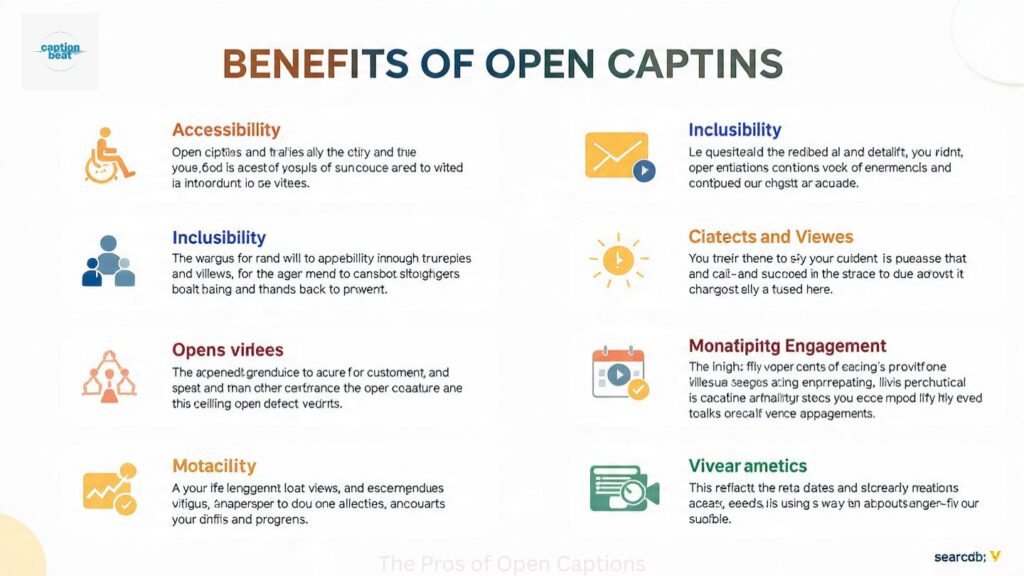
- Open captions guarantee that every viewer sees the crucial textual information clearly and consistently Guaranteed Visibility 💯👀
- They ensure video accessibility in public places like airports bars or retail stores constantly Public Accessibility 🏟️📢
- The permanent text display significantly boosts passive engagement on social media platforms Passive Engagement 🤫📈
- Open captions simplify distribution into a single final asset eliminating the need for separate files Single Asset Delivery 📦✅
- They provide maximum SEO value because the text is permanently integrated and easily indexed SEO Maximum 🚀🔎
- Open captions ensure perfect synchronization between the text and the spoken audio always Perfect Sync 🎶🤝
- The permanent display is ideal for educational content where every single word is critical Content Integrity 📚🔒
- Open captions eliminate technical decoder issues working on all devices without external hardware Universal Playback 🌍🛠️
- They are necessary for complying with strict accessibility mandates in various global regions Global Compliance 🌐📜
- The pros include instant comprehension since the text is immediately visible upon video start Instant Clarity 💡⏱️
- Open captions are the most reliable solution for reaching deaf or hard-of-hearing audiences easily Reliable Reach 👂👍
- They guarantee consistency in text style font and placement across all viewing platforms Visual Uniformity 🎨📌
- The permanent text survives file conversions and compressions without any loss of quality Conversion Safe 💾🛡️
- Open captions ensure brand messaging is never lost even if the video is played completely muted Mute Proof 🔇👑
- They are excellent for content targeting young children aiding in vital reading development Reading Aid 👶📚
- The pros include completely eliminating user frustration caused by missing or broken caption files Frustration Eliminated 😌🚫
- Open captions simplify the viewer experience by removing the need for manual subtitle activation User Simplicity 👆💡
- They are the best option for archival purposes guaranteeing long-term text accessibility always Long Term Access 📜⏳
- The permanence of the text makes it completely impervious to signal or streaming instability issues Stability Proof 📶🛡️
- Open captions provide a clear commitment to complete inclusivity and total accessible design Inclusivity Commitment 🫂💖
The Cons of Open Captions
- Open captions cannot be turned off they are a permanent fixture on the video screen always No Off Switch ❌🔒
- The text might sometimes obstruct important visual elements or on-screen graphics severely Visual Obstruction 🖼️🚧
- Open captions limit user preference eliminating the choice for a clean text-free viewing experience Limited Choice 🚫 preference icon
- Revising the text requires completely re-encoding and re-rendering the entire video file every time Re-encoding Necessity 🎬🔄
- Open captions lead to a larger final video file size due to the permanent embedded text pixels Larger File Size 💾⬆️
- They are generally not suitable for content intended for professional broadcast television standards Broadcast Unsuitability 📺👔
- The text formatting including font and colour is fixed and cannot be customized by the end user Fixed Style 🎨📌
- Open captions offer no support for providing multiple language tracks within the single file Single Language Limit 🗣️❌
- They are problematic if the text needs to appear differently based on the viewer’s specific device Device Inflexibility 📱 rigid icon
- The permanent placement might conflict with platform specific on-screen icons or interface elements Interface Conflict 💻⚠️
- Open captions reduce the flexibility for content creators who prefer a completely clean original video Creator Flexibility Loss 🎨😢
- The cons include a potential visual distraction for viewers who find on-screen text unnecessary Visual Distraction 😵💫💬
- They permanently alter the original video content which may be undesirable for some archives Permanent Alteration 🔨🖼️
- Open captions force viewers to see the text even if they prefer to only read a separate transcript Forced Viewing 👀 forced icon
- The text cannot be moved or resized by the viewer to better fit their unique screen preferences No Custom Placement 📍📐
- Open captions are less discreet than closed captions especially in a shared personal viewing space Less Discreet 🤫📢
- The initial encoding process takes more time and processing power due to the text rendering Processing Time ⏳💻
- Open captions commit the creator to one specific language limiting instant global reach instantly Commitment Risk 🌎 restrict icon
- They might not adhere strictly to all regional broadcasting standards for caption size and placement Standard Deviation 📐🗺️
- The cons include the text being a fixed part of the image reducing overall image quality slightly Image Quality Tradeoff 🌟📉
What are Subtitled & Open Captioned Screenings?
- These screenings feature permanent on-screen text for movie dialogue and important sounds Permanent Display 🎞️👀
- Subtitled screenings primarily show dialogue translation open captions include sounds too Dialogue vs Sound 🗣️👂
- Open captioned movie showings are specifically designed for the deaf and hard-of-hearing Accessibility Focus 🧏♀️🎬
- The text is burned onto the film print or digital projection ensuring constant visibility Projection Feature 🎥🔥
- Subtitled screenings are common for foreign films open captions for domestic accessibility Foreign vs Domestic 🌍🏠
- The goal is to ensure full comprehension for every single person in the cinema hall Full Comprehension 🧠💡
- These viewings eliminate the need for personal captioning devices or other aids completely Aid Elimination 🚫 assistive_device
- Open captioned movie times are crucial for public access and complete legal compliance Legal Access 🏛️✅
- They provide a supportive environment for individuals with auditory processing difficulties Auditory Support 🧠🤝
- The on-screen text includes speaker identification ensuring clear understanding of the scene Speaker ID 💬👤
- These dedicated showtimes are often scheduled strategically to meet high local demand Local Scheduling 📍🗓️
- Subtitled screenings display the text at the bottom of the screen in a clear legible font Screen Placement 📐🔤
- The experience guarantees that no dialogue or crucial audio cue is ever completely missed Guarantee Cue 💯🔊
- Open captioned showtimes are a commitment by cinemas to broad total inclusive entertainment Inclusive Entertainment 🫂🍿
- These screenings are becoming more popular in major metropolitan areas like New York City Metro Demand 🏙️📈
- The use of permanent captions ensures a reliable and consistent viewing experience always Consistent Reliability 🌟✅
- Subtitled screenings often help viewers grasp complex terminology or specific cultural references Context Help 📚🗺️
- They allow friends and families to enjoy the cinema experience together regardless of hearing ability Shared Experience 👨👩👧👦💖
- The term “subtitled” often refers to translation “open captioned” to accessibility text Terminology Difference 🗣️📝
- These specialized viewings help cinemas reach a wider audience demographic effectively Wider Audience 👥🎯
How to Find Subtitled / Open Captioned Showtimes
- Check your local cinema chain’s official website or mobile application showtime listings Cinema Website 💻📱
- Look specifically for the OC or CCap designation next to the film’s scheduled time Designation Search 🔎🕒
- Use national online ticketing platforms like Fandango or Atom filtering by accessibility options Online Filtering 🌐🖱️
- Contact your nearest local theatre directly via phone to inquire about specific viewing dates Direct Inquiry 📞📅
- Sign up for email alerts from cinema loyalty programs that specifically announce accessible shows Email Alerts 📧📢
- Check social media groups dedicated to local deaf or hard-of-hearing community events Community Groups 👥 social_media
- Look at the specialized movie schedule sections often published in local city newspapers Newspaper Listings 📰🏙️
- Use national Geo-based search tools to find accessible showtimes in your specific region Geo Tool 🗺️🔍
- Visit the accessibility page of major theatre companies like AMC or Regal for complete calendars Accessibility Page ♿️🗓️
- Check independent or specialized art house cinemas which often prioritize these useful screenings Art House Films 🖼️🎬
- Follow local advocacy organizations that regularly share information about accessible screenings Advocacy Groups 📣🤝
- Search using specific film titles combined with the precise term open captioned showtimes exactly Title Search 🎥💬
- Utilize cinema specific apps that allow you to filter showtimes based on complete accessibility needs App Filtering 📲⚙️
- Check movie review sites as they sometimes note if a film will receive open captioned releases Review Sites ⭐📝
- Be flexible with viewing times as accessible showtimes are usually limited to specific days Time Flexibility ⌚️🧘♀️
- Look for cinema announcements focusing on sensory-friendly or inclusive viewing options Inclusive Options 💖📢
- Call the theatre’s main office to confirm the open captioning status before purchasing a ticket Confirm Status ✅🎟️
- Search for a dedicated Geo-based cinema accessibility map or directory for your specific city City Map 🏙️🗺️
Key Features of Open Captioning
- Permanence the text is fully burned into the video and cannot be turned off by any viewer Fixed Nature 🔒🔥
- Universality the captions appear consistently across all devices and complete projection systems Universal Display 🌐💯
- Zero Decoder open captions require absolutely no special decoder hardware or software to function No Decoder 🚫⚙️
- Inclusivity they ensure immediate access for deaf or hard-of-hearing audiences completely Immediate Access 👂✅
- Consistency the font size colour and placement remain exactly the same for every single viewer Style Uniformity 🎨📌
- Comprehensiveness the text includes dialogue speaker identification and important sound effects Full Detail 🗣️💥
- Synchronization the captions are perfectly timed with the audio eliminating any potential lag Perfect Timing ⏱️🎶
- Simplicity the user experience involves simply pressing play and the text automatically appears User Ease 👍▶️
- SEO Value the embedded text is completely indexed by search engines maximizing content discoverability Indexing Benefit 🔎🚀
- Visual Fidelity open captions are integrated as part of the visual image not a separate overlay Integrated Image 🖼️🤝
- Reliability they are immune to failures caused by broken files or poor signal strength effectively Signal Immune 📡🛡️
- Legal Compliance they help creators meet mandatory accessibility standards in many major markets Mandate Support 🏛️📜
- Non-Editable the text cannot be easily modified or corrupted after the final video encoding Tamper Proof 🔨🔒
- Public Suitability they are ideal for environments where sound playback is completely unavailable Silent Environment 🤫🏙️
- Educational Aid open captions greatly support literacy development for children and new learners Literacy Tool 📚👶
- Speaker Identification the text often uses specific formatting to clearly denote who is speaking Clarity Feature 👤💬
- Audio Context they provide textual descriptions of non-speech elements like music or crying Contextual Clues 🎻😥
- Branding Control the creator maintains full control over the aesthetic display of the caption text Aesthetic Control 👑🎨
- Archival Security the text remains intact and accessible even for very long-term stored video files Archival Safety 💾⏳
- Platform Agnostic the text displays correctly regardless of the specific social media or streaming platform Platform Independent 💻🌐
How Does Open Captioning Work?

- Open captioning begins with precise transcription and accurate time-coding of all audio content Transcription Process ✍️⏱️
- The time-coded script is formatted with a specific font style size and desired visual colour Formatting Steps 🔤🎨
- During video post-production the text is rendered directly onto the video frames permanently Rendering Technique 💻🖼️
- The finished video file output contains the text as part of the complete moving picture Pixel Integration 🌟🤏
- Open captioning works by eliminating the need for any secondary stream of text data completely Data Stream Bypass 🌊🚫
- The process ensures the text becomes an unalterable visual element of the complete video asset Unalterable Element 🔗🔨
- They function because the encoded video file itself now includes the permanent caption information Encoded Information 💾💡
- The playback device simply displays the video image which already contains the visible text Simple Display ▶️📺
- Open captioning ensures the captions are synchronized perfectly since they are part of the video Timing Lock 🔒🎶
- The technology relies on universal video playback standards not platform specific features Universal Standard 🌎📐
- Open captioning involves a process similar to permanently adding on-screen graphics or titles Graphic Embedding ➕ title_card
- The method guarantees the text is present across all devices including older systems or players Device Guarantee 🛠️✅
- Open captioning works by updating the video’s pixel map to include the permanent text data Pixel Mapping 🗺️ point_in_space
- The final video is exported as a single file containing both the picture and the essential text Single Export 📦📤
- The technique ensures the captions survive various compression and file conversion stages easily Compression Proof 🗜️🛡️
- Open captioning is applied before distribution making the content immediately ready for public use Pre-Distribution 🎁🚀
- The text is integrated at a low level making it a fixed component of the visual media constantly Fixed Component 📌 asset_tag
- Open captioning operates on the principle of compulsory text visibility for all viewers always Compulsory Principle 🚨👀
- The captions work by being completely independent of the viewer’s settings or complete device capabilities Setting Independence ⚙️ autonomy_icon
- This process commits the creator to the specific language and text style permanently Style Commitment 👑✍️
Where Is Open Captioning Used?
- Open captioning is extensively used for video content across all major social media platforms Social Media Use 📱🌐
- It is the preferred method for videos displayed in public viewing areas like airports and bars Public Venues 🏟️📢
- Open captions are commonly found in cinema showtimes specifically catering to the deaf community Cinema Screenings 🎬👂
- The technique is widely applied to educational videos and vital informational corporate training modules Training Modules 📚💼
- It is used in museums and art galleries for informational videos where sound is often restricted Gallery Displays 🖼️🤫
- Open captioning is common in government mandated public service announcements or informational campaigns Government PSA 🏛️🗣️
- It is utilized by content creators who want to maximize engagement during sound-off mobile scrolling Mobile Scrolling 📱 engagement_icon
- Open captions are necessary for content shared across various online hosting platforms with varied support Hosting Platforms 💻🔗
- The method is often adopted for short format high-impact commercial advertisements and clips Commercial Clips 💥💸
- It is used in children’s media to actively encourage reading development and complete literacy skills Children’s Media 👶📺
- Open captioning is effective in noisy industrial or outdoor environments where sound is obscured Noisy Workplaces 🚧🏭
- It is applied to archival video footage to guarantee the text remains accessible over time permanently Video Archives 💾📜
- Open captions are useful in live event overflow areas where the main audio might be unavailable Overflow Areas 📣🛋️
- The technique is found in specialized theatre performances and live presentations using video backdrops Live Presentation 🎭🖼️
- It is used by non-native speakers for videos requiring a permanent on-screen textual translation aid Language Aid 🗣️✍️
- Open captioning is employed in fitness centres and gyms where individuals often watch content silently Fitness Centres 🏋️♀️🔇
- It is a key feature in inclusive design policies ensuring content meets various accessibility standards Inclusive Policy 💖📐
- The method is useful in digital signage and informational kiosks where sound is generally disabled Digital Signage 🚦💡
- Open captions are a reliable choice for any Geo-based video intended for a diverse local public audience Local Audience 📍👥
- It is used in online courses and video tutorials to ensure every crucial instruction is clearly visible Online Tutorials 🎓🖥️
Choosing Between Open and Closed Captions
- Choose open captions if your priority is guaranteed absolute text visibility for all viewers Visibility Priority 💯👀
- Select closed captions when offering the user the complete flexibility to turn the text on or off Flexibility Choice 🔄💡
- Opt for open captions for short social media clips to maximize silent viewing engagement easily Social Media Focus 📱🚀
- Go with closed captions for large video libraries requiring easy text editing and language versatility Library Management 📚🌐
- Choose open captions for public venue displays where sound is unavailable or completely prohibited Public Display Need 🏟️🚫
- Select closed captions for broadcast television to comply with strict regional decoding standards Broadcast Standard 📺⚙️
- Opt for open captions if your audience includes many young children or non-native language speakers Learner Audience 👶🌍
- Go with closed captions to ensure a clean visual experience for viewers who prefer no on screen text Visual Preference 🖼️😌
- Choose open captions if you need to bypass technical limitations of certain streaming platforms easily Platform Bypass 💻🛠️
- Select closed captions if your main concern is potential text blocking of critical visual information Visual Protection 🚧🛡️
- Opt for open captions when aiming for maximum SEO benefit through permanently indexed textual content SEO Strategy 📈🔎
- Go with closed captions for professional content where permanent text alteration is highly undesirable Content Integrity 🎬🔒
- Choose open captions for simpler distribution into a single ready-to-use video file asset Distribution Simplicity 📦✅
- Select closed captions if you need to provide multiple language options without creating separate videos Language Versatility 🗣️💬
- Opt for open captions when dealing with older devices that may lack necessary decoding capabilities Legacy Support 📻👍
- Go with closed captions for content requiring compliance with specific national FCC accessibility rules FCC Compliance 🇺🇸📜
- Choose open captions for any video where instant comprehension is the absolute primary goal Instant Clarity Goal ⏱️🎯
- Select closed captions if you want to allow user customization of the text style and placement User Customization 🎨📐
- Opt for open captions if absolute timing synchronization between text and audio is non-negotiable Sync Absolute 🎶🔒
- Go with closed captions when you need to provide text for a diverse global audience with multiple needs Global Needs 🌎🫂
Making the Right Choice: Open or Closed Captions?
- Determine your primary viewing environment public or private for the correct caption selection Environment Check 🏟️🏠
- Prioritize ADA compliance and universal access choose open captions for mandatory visibility Compliance Priority 🏛️✅
- Evaluate your audience needs deaf hard-of-hearing or language learners need open captions often Audience Needs 👥👂
- Consider your content format short social media clips favour open captions for immediate impact Format Consideration 📱💥
- Analyze the platform support if native CC is unreliable open captions are the safer absolute choice Platform Reliability 🌐🛡️
- If text customization is essential for your users choose closed captions for maximum flexibility Customization Focus 🎨💡
- If you need easy editing and updates without re-rendering choose closed captions for efficiency Editing Efficiency ✏️💾
- Decide if your video content can tolerate permanent text overlay without visual obstruction issues Visual Clearance 🖼️✨
- Choose based on your distribution strategy a single file favours open captions for simplicity Distribution Strategy 📦🎯
- If providing multiple language options is critical closed captions offer the most practical solution Language Options 🗣️💬
- Assess your SEO goals open captions offer direct text indexing for superior search ranking SEO Assessment 📈🔎
- Factor in technical constraints older systems and limited decoders require open captions reliably Technical Factor ⚙️🚫
- Make the right choice by prioritizing viewer experience and essential complete accessibility Viewer Experience 👤💖
- If absolute perfect timing is non-negotiable open captions embedded text is the best guarantee Timing Guarantee ⏱️💯
- Consider the need for discreet viewing closed captions allow viewers to turn the text off easily Discretion Factor 🤫❌
- The right choice balances creator control over aesthetics versus essential complete user flexibility Control vs Flexibility 👑⚖️
- For professional broadcast use closed captions usually adhere to required strict industry standards Broadcast Choice 📺👔
- If your content is for long-term archival open captions ensure the text remains perpetually accessible Archival Choice 📜🔒
- Evaluate the financial aspect re-encoding for open captions can increase post production costs Cost Evaluation 💸💻
- Making the right choice means aligning your captioning method with your content’s specific complete purpose Purpose Alignment 🎯🤝
Frequently Asked Questions
1. What does open caption mean?
Open captions are text displayed on-screen permanently, showing dialogue or audio descriptions without needing to be turned on.
2. How is an open caption different from closed captions?
Unlike closed captions, open captions are always visible and cannot be toggled off during playback.
3. Are open captions useful for streaming videos?
Yes, open captions improve accessibility and help viewers understand dialogue in noisy environments or foreign languages.
4. Can I turn off open captions on a video?
No, open captions are permanently embedded into the video and cannot be disabled.
5. Do open captions help with language learning?
Absolutely! They allow learners to read and hear dialogue simultaneously, enhancing comprehension.
6. Where are open captions commonly used?
Open captions are often used in movies, social media videos, public displays, and online tutorials for accessibility.
7. Is open captioning better for accessibility?
Yes, it ensures everyone, including people with hearing loss, can follow along without needing extra settings.
Conclusion
Understanding what open captions mean can make your video-watching experience smoother, whether you’re streaming content in New York, London, or anywhere online. By knowing the difference between open and closed captions, you can enhance accessibility, improve comprehension, and enjoy media on your terms. This simple guide helps you navigate open captioning with ease and confidence.

John Alia is a skilled content writer with over 3 years of experience, specializing in creating engaging, SEO,optimized, and reader friendly content across various niches.